Buffing and Polishing by Bathroom Surface Solutions
The short answer
Buffing and polishing is a finishing step that smooths out small dust nibs, debris or rough spots that can show up while a refinished coating cures. The surface ends up clean and glossy. At Bathroom Surface Solutions it is included at no extra charge.
Published Last reviewed
In this video, Isaiah does a professional buff and polish on a refinished bathtub. It is a small finishing step that makes a visible difference, and it is part of how we close out every bathtub refinishing job.
What is a buff and polish?
Buffing and polishing smooths the top of a cured coating with fine wet sandpaper, then brings back the gloss with polishing compound. Think of it like wet-sanding and polishing a car's clear coat. The coating itself is sound. The very top just gets perfected by hand.
Why would a refinished tub need it?
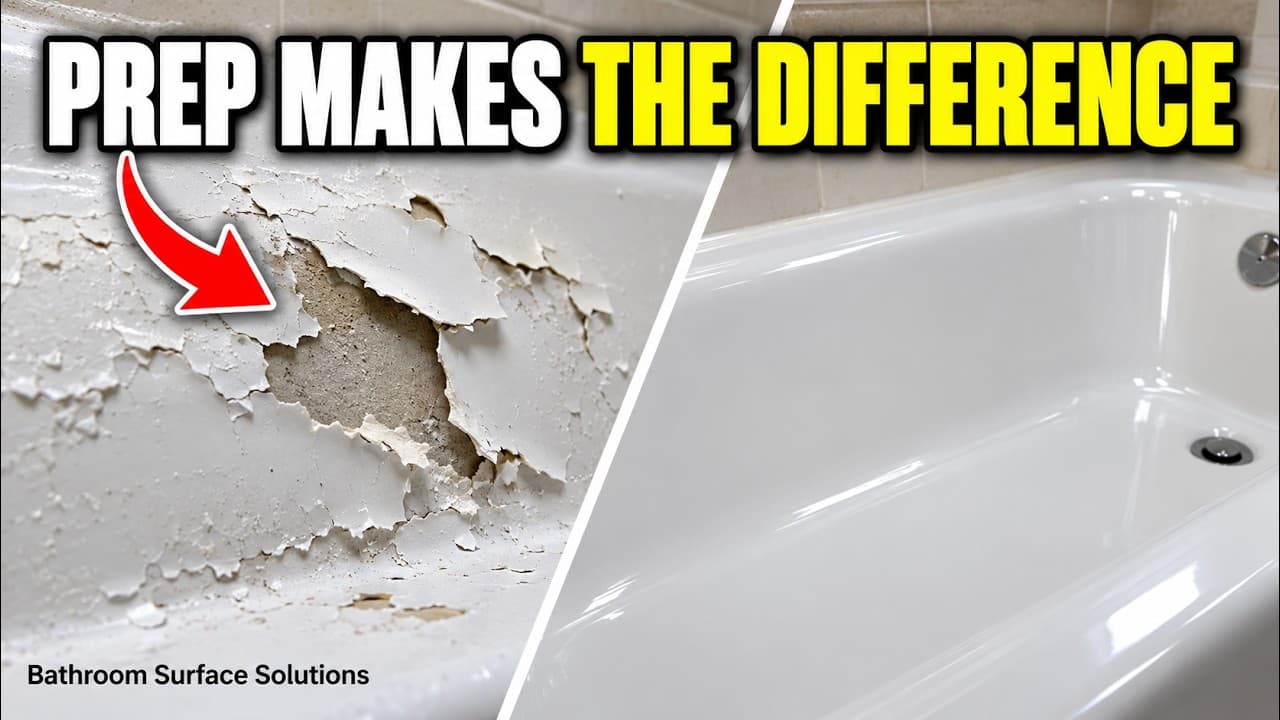
Coatings get sprayed in a real bathroom, not a dust-free factory. Small dust nibs or rough spots can show up while the coating cures. When that happens, we smooth and polish the area back to a clean, glossy finish. It is normal, it is expected, and fixing it right is part of doing the job. The same care starts with proper prep and adhesion.
Does it cost extra?
No. It is part of finishing every job to our standards, at no extra charge. If your surface needs a buff and polish, that is on us, not on your invoice.
How is a buff and polish done?
- Let the coating cure enough to be worked safely
- Inspect the surface and mark any nibs or rough spots
- Wet-sand the marked areas smooth, feathering into the surrounding finish
- Polish the whole area with compound to bring back an even gloss
- Final check under light from several angles
The result is a finish that looks and feels like a showroom tub: smooth, evenly glossy and ready for daily use. See what is included on our bathtub refinishing service page, or book a free estimate to get your tub on the schedule.
Frequently asked questions
No. Done by a pro, buffing only refines the very top of the coating. The thickness and adhesion underneath stay untouched, and the polished surface is smoother and easier to clean.
The coating needs time to cure first. It is usually handled at a follow-up visit shortly after the job, and we schedule it as part of your project.
Not always. Many jobs cure smooth enough on their own. When small nibs or rough spots do show up, we take care of them. It is included in the job, not an upsell.
Read the full transcript
Hey, Isaiah here with Bathroom Surface Solutions, CCB 181883. Got a bathtub here and a shower wall that we have refinished recently, and today I want to talk about common issues when it comes to refinishing. One in particular — the reason I'm back at this one a few days after it's dried — is there's a little bit of dry spots on it from dry spray, a mixed texture feeling on the walls, on the floor. What we have here basically is just some dry spray: a little bit too far away, maybe the gun air is not high enough or the gun output's not high enough. The best way for us to fix this, if it's bad enough, is a respray. I came the other day and felt this one — doesn't seem too bad at all. So I've got a buffing and polishing kit I'm going to grab. I'm going to do a wet sand with typically 1,500, 2,000, 3,000 sandpaper — it's got to be wet. What it'll do is just scuff the material down, make it smoother. Then I'll use a polishing compound with a polishing pad and machine and just smooth out the entire surface the rest of the way, basically to bring the shine back up. What happens when you buff it, it dulls it a little bit because you're trying to knock down the material, but the buffing is going to retain the shine and bring it back to life, essentially. So I will get this going and we'll see what happens.
Just a little bit, not too bad — you can actually feel it on the interior walls. The reason that actually happens is when we're going back and forth, the spray bounces and hits the sides, leaving a little bit more of a dry spray on the side. That can definitely happen when we're finishing, but the simple solution: we'll do a buff and polish, and it'll be nice and smooth again.
The customer also did note a little bit of a sag/run there, so I'm going to get that out. Same process: 1,500 grit probably first, nice and light wet, then 2,000 and 3,000.
Fantastic. Okay, done the buffing — I'm going to dry this thing off, then we're going to work on the polishing. There was one little hair — where did it go? — embedded in the surface; I'll just get that out real quick. That's the fun part about working in a bathroom and not a paint booth: the debris is uncontrollable. We'll get some dust nibs sometimes — completely normal. We ventilate, we clean as much as possible, but we can't 100% guarantee that it ain't going to have a little bit of debris in there. That's why we always offer the buff and polish. There we go. All right, we did it.
So we got a buff and polish — a common issue with spraying. Not every job; some jobs need a buff and polish — just a little bit of roughness, a little bit of dry spray. But yeah, that's it. I'll give you a show real quick. And this caulking has not been completed. So we got ourselves a tub and surround refinish — the price of this one, much, much less expensive than replacement. This is a commercial building, we're at an apartment complex. We do commercial work all the time, and it saves complexes a lot of money going this route compared to replacing. We're here for you. Again, my name is Isaiah, Bathroom Surface Solutions, CCB 181883. Thank you so much.